
Children’s reactions
Hello everyone, how are you? This is Tanaka from GRIDFRAME.
<Siphon Coffee>
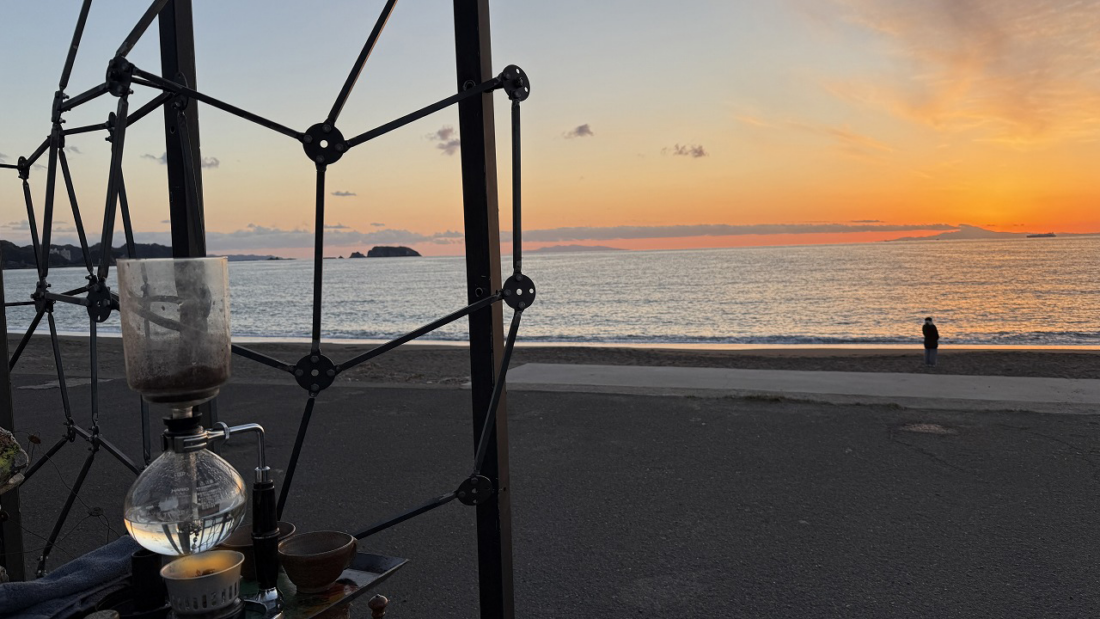
When I was a student in Kyoto, one night on a whim, my friend and I loaded coffee beans and a siphon into the car’s seat and drove to the beach to drink coffee. In the early morning, we arrived at the Wakayama coast in the twilight, and I can still hear the sound of the waves as we placed the siphon on the roof of the car and lit the alcohol lamp.
After quietly sipping my coffee, I headed back to Kyoto. That was all there was to it, but for some reason, I’ve never forgotten it, and the memory comes back to me from time to time. …Perhaps in that very simple moment—spending time with someone to brew coffee somewhere far away—I touched something irreplaceable.
I hope it was a good time for your friend as well.
<Tea Room Trailer>
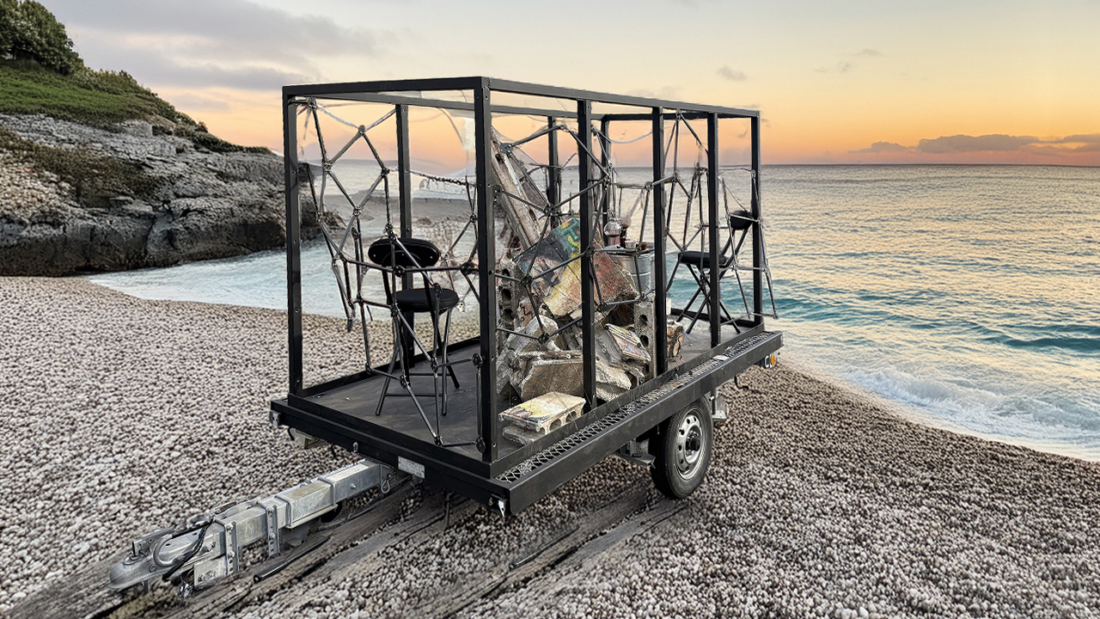
As I reminisced about all that and rebuilt the trailer that was carrying all sorts of broken things, I suddenly found myself creating a mobile tea room. I realized that it must have been a tea ceremony.
Once you create it, you’ll find that broken objects become essential to realizing the wabi aesthetic of the tea ceremony, “like tying a fine horse in a thatched hut.” The freely shaped GRIDFRAME system loosens the boundary between inside and outside, and you can enjoy siphon coffee in an environment where objects liberated from the meaning of “broken” reside within. Would Rikyu recognize this as a tea room?

<Along with the graffiti of Shimokitazawa>


A long-established building that has been a familiar sight in Shimokitazawa for many years is being demolished. Built in 1962, its exterior was covered in graffiti, symbolizing the subculture of the town. It was painted with layers upon layers of high-energy graffiti and haphazardly sprayed paint, plastered with stickers, and was apparently often used as a backdrop for photo shoots by rock-loving youth.
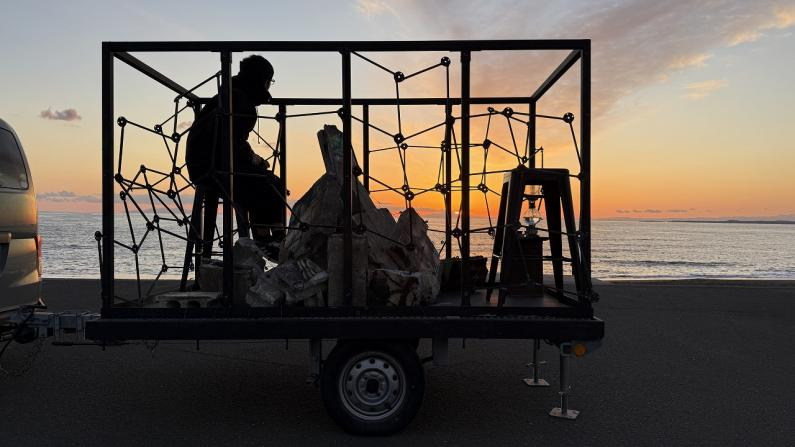
Currently, the broken items being transported in the tea room trailer are fragments of walls received during the demolition of this building, piled haphazardly in the middle of the trailer. Colorful fragments covered in age-related grime, fragments resembling cows from the Lascaux Caves, fragments of Native American faces… They are wrapped in GF mesh and held in place to prevent them from falling out during transit.
You can ignore these things, or you can gaze upon them, or you can shape the GF mesh, place a coffee cup on it, rest your feet on it, or freely interact with the broken objects. Nothing is forced upon you.
With those broken objects in the middle, the two of us sit on either side, and I slowly grind the coffee beans, light the alcohol lamp, and brew the coffee using a siphon. The boiling water rises slowly, and when the flame is extinguished, it slowly descends.
All that’s left is to share the time spent drinking coffee together.
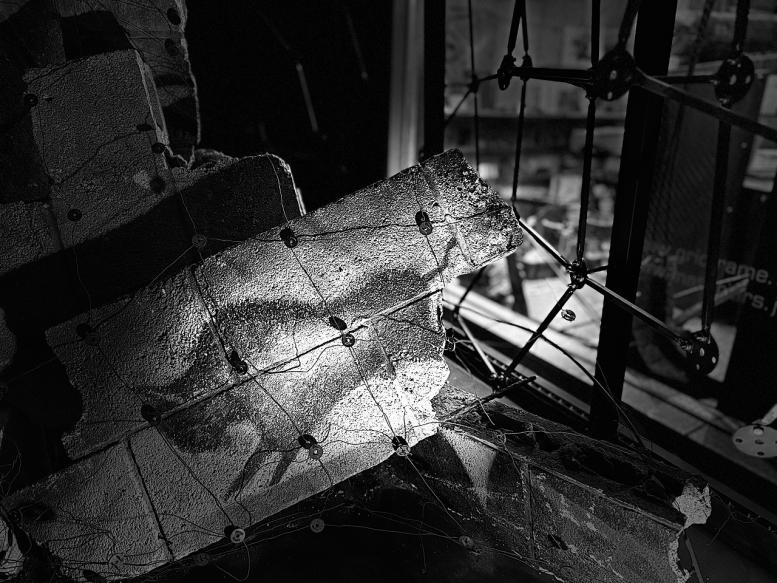
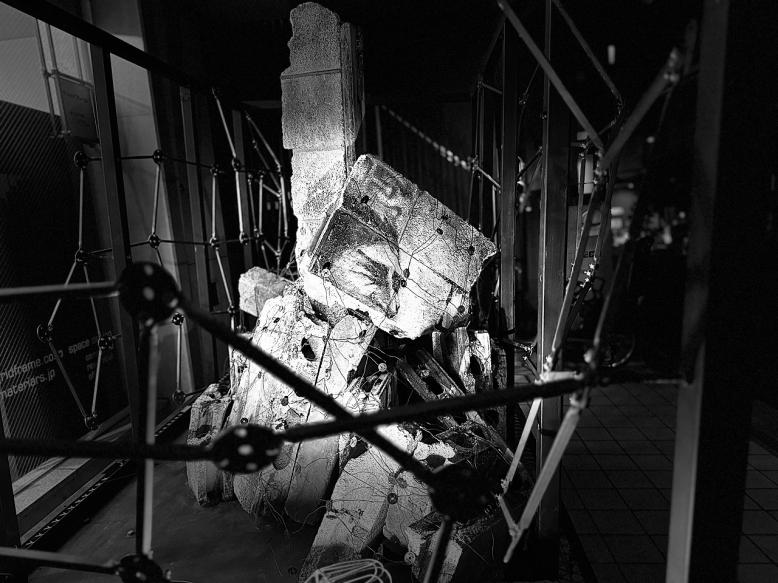
The broken items will be updated each time we collect more SOTOCHIKU material.
<A constantly evolving form as it moves forward>
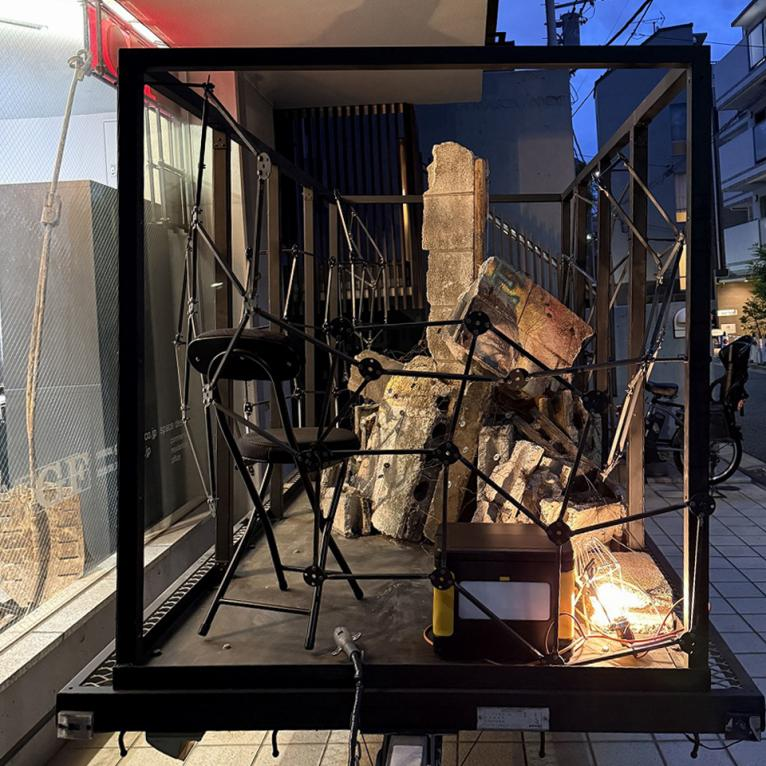

Before driving the car After driving the car
The broken items piled on the trailer are secured with GF mesh to prevent them from falling, but the act of stacking them in a way that prevents them from falling inevitably involves human intent, giving it a somewhat artificial appearance. (Photo on the left)
However, as the car moves, the piled-up objects search for loose spots in the mesh, automatically changing the shape of the mountain with each vibration. This is an uncontrollable, irreversible generation where the environment itself—gravity, vibration, and time—functions as a sculptor. (Photo on the right)
All we can do is make this happen while taking the utmost care to avoid any accidents. We laugh at ourselves for controlling not controlling anything with such precision. But this is what we’ve always wanted to do lol.
<Children’s reactions>
Something wonderful happened while I was writing this.
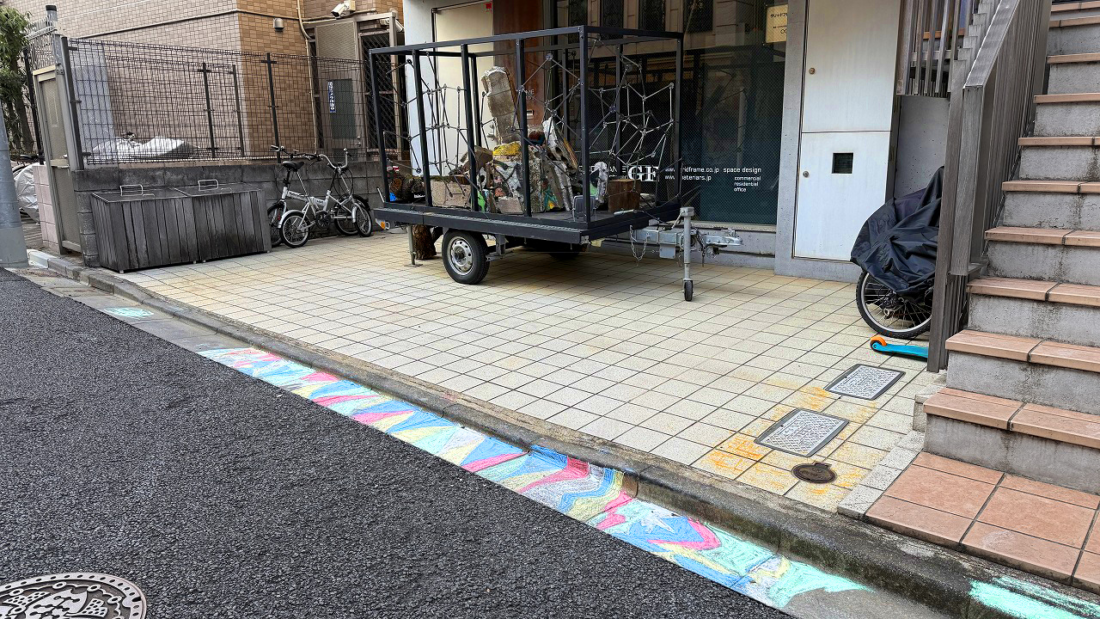
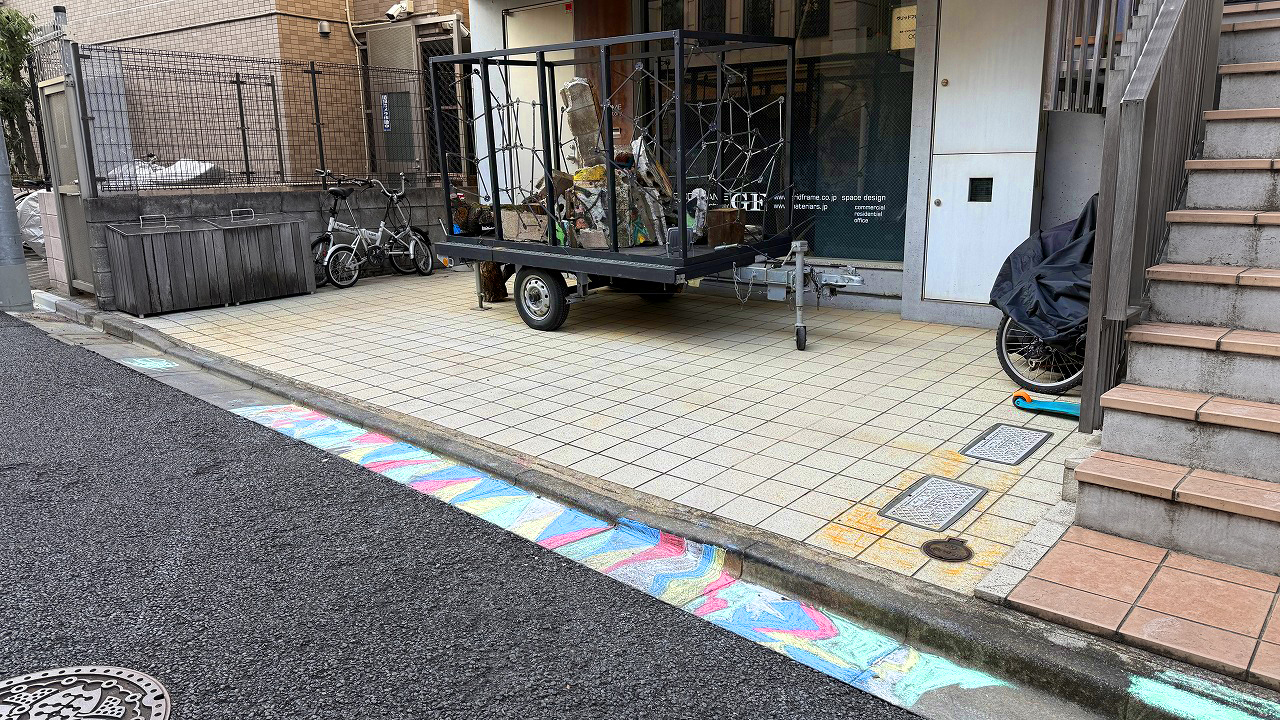
When I parked this trailer in front of the GRIDFRAME office in Omotesando, the neighborhood kids responded by drawing graffiti on the road.
This area, a 10-minute walk from Omotesando Station, is not exactly known for having many children, but recently I’ve occasionally seen young elementary school children happily riding their small bicycles around.
The children certainly didn’t “understand” the tea room trailer, nor did they grasp its concept, nor did they have any memories of Shimokitazawa. …Nevertheless, I think their bodies reacted to it.
Omotesando, a sophisticated and well-managed area, possesses a tightly closed-off nature, with transparent boundaries that do not allow for deviation.
There, a pile of broken concrete blocks, bearing traces of the subculture lost in Shimokitazawa, temporarily docked.
This is a state in which a different phase of time and different values is inserted into the continuity of the city. The phase of the city “loosened” for just a moment.
The children simply sensed that the boundary had momentarily weakened.
I think this has created an opportunity where it might be acceptable to paint on roads that are usually considered off-limits.
What happened here was that, for a brief moment, the attitude of accepting traces returned to the city, without anyone’s intentions involved.
I wrote “in an instant” many times. True to my word, the next day the chalk graffiti was completely erased without a trace. We sincerely hope that those children were not scolded.
I believe that the creation of GRIDFRAME doesn’t need to be understood or appreciated by everyone. However, I believe that it leaves room for different behaviors to emerge.
This graffiti has given us confidence as small but irrefutable proof that such space definitely existed. We are truly grateful to those kids.
<As a structure for “survival”>

For New Year’s Day 2026, my wife, our son, and I went on a road trip by car. Our station wagon has been modified so that a wooden floor can be installed in the back, 40 centimeters above the floor, allowing the three of us to sleep in sleeping bags.
After traveling a long distance, we decided to sleep at a highway service area. When we first bought this car, my son was small, so the three of us could sleep on the wooden floor, but now that he’s grown, it’s too cramped for all three of us to sleep comfortably. So, I decided to sleep by myself, crawling under the wooden floor.
The space under the floor is less than 40 centimeters high, so it’s a tiny space where you can’t even turn over in your sleep. Well, I’m just going to sleep wrapped in a sleeping bag, so I figured it wouldn’t be a problem and lay down. I was so restricted in my movements that I could barely even get into the sleeping bag, but I was tired, so I fell asleep in a somewhat unnatural position.
After sleeping comfortably for about five hours, I woke up around 4 a.m. feeling uncomfortable in that unnatural position. For about 30 minutes I fidgeted around, changing my position and the position of the sleeping bag as much as I could move, but it wasn’t easy. Suddenly, this tiny space became unbearable.
I have to get out of here! If I’m lying on the floor, I can easily get out through the door on the side, but there’s no way to get out from underneath. The rear door, right in front of my head, is a hinged door and can never be opened from the inside. I’m trapped, unable to move, and unable to escape. The more I think about my situation, the more unbearable it becomes, and I’m almost going crazy.
The two people on the floor were fast asleep, but I pretended to be calm and tapped on the floor from below. Then I called my wife’s name. My wife noticed me immediately, got out through the side door, and opened the rear door from the outside, averting disaster. I quickly crawled out of the tiny space and took a deep breath in the freezing cold outside the car. …
After some time had passed, I thought about what had happened inside me.
What I found strange was that I could stay there for more than five hours without any problem until I could no longer tolerate the environment. Nothing had changed. What had changed was my way of thinking.
Following Atsushi Mori’s example, if we define thinking from within (open sets), which are open because they do not belong to any boundaries, as internal thinking (subjective), and thinking from outside (closed sets), which are closed because they belong to any boundaries, as external thinking (objective)…
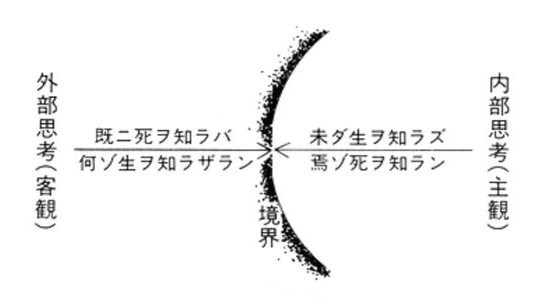
Internal thinking: To see from the inside means never reaching the “edge (boundary),” but always finding something beyond (inside). It refers to a state of freedom where the self exists purely as itself, undefined by external factors.
External thinking: Viewing from the outside refers to a state that is framed and fixed by boundaries. It refers to a state that has been objectified and fixed as a “thing” by an external gaze.
During the time I was able to stay there without any problems, I was subjectively dealing with the situation through internal thinking that was open because I didn’t belong to any boundaries. However, the moment I began to objectively grasp my situation, my thinking shifted to external thinking that was closed because I belonged to boundaries, and I realized that the fact that those boundaries were so narrow was what had cornered me.
Every aspect of things belongs to a boundary, and external thinking, which is the boundary to which one belongs, treats people as objects and relentlessly confronts them with all their characteristics, sometimes endangering the existence of those who are not resilient to them.
Like a Mobius strip, the continuous alternation of external and internal thoughts—that is, the “connection”—enriches people’s lives. Or at least prevents them from collapsing. In past communications, I’ve written about the power of things that have broken down many times to “inspire” vulnerable people, but I’ve personally learned the importance of creating an environment where one can “survive” even before being inspired.
In this instance, when my external thinking reached a critical point and I was in a critical state, what I needed was the intervention of another person (my wife) who could reverse my external thinking into internal thinking, but we try to create that space for it.
I call that approach to production “topological production.”
“Topological creation involves thoroughly removing pre-existing meanings and the arbitrary intentions of the creator, returning materials and space to their pure ‘structure,’ and designing a ‘phase’ in which new meanings are continuously generated through the intervention of the user and time.”
More than 30 years ago, when I began studying architecture in the United States, I came across a book by Atsushi Mori called “The Transformation of Meaning,” which was based on the mathematical field of topology. Since then, I have always made it a condition of my spatial design to remove pre-existing meanings.
The following is a text I wrote 31 years ago, but it reflects GRIDFRAME’s production philosophy, which remains unchanged to this day.
<Crosby Hall>
https://www.buffalo.edu/ubnow/ub-seen/slide-shows/2022/12/crosby-hall-renovation.html
A space crafted with meticulous care is something to be grateful for .
Those who sense the passion of its creator
will strive to behave in a manner befitting that space…
So, does that mean that a space that may not have been meticulously crafted
can be used however you like?
Does that mean that any kind of behavior is permissible there? …
If so, wouldn’t that be far more interesting?
This paradox should be particularly relevant to students studying architecture or art.
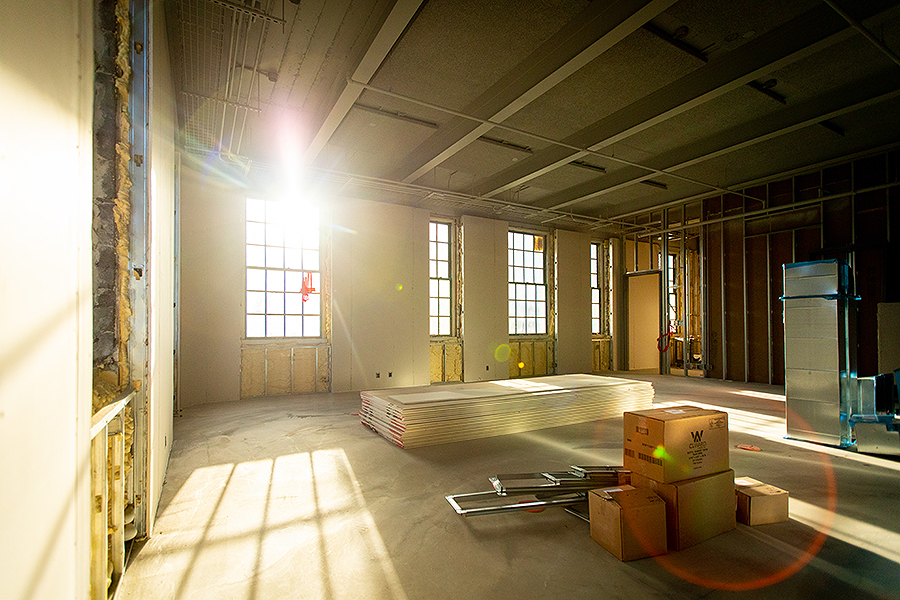
Crosby Hall, the building of the architecture department at the State University of New York where I studied architecture, was an old space completely freed from the passion of its creators.
That’s precisely why students could use the building however they liked for their own projects—
painting, graffitiing, punching holes in the walls, and so on.
For those who dedicate themselves to creation,
the passion of the creator of the space that serves as their creative environment
can sometimes even be a hindrance.
I myself am one of those who deeply love Crosby Hall for this very reason.
After a long time has passed, the space where many things have been forgotten
seems to be smiling quietly at all of us
(haven’t you ever felt that way too?)
When you experience the sense of freedom that such a space offers, doesn’t it somehow give you a distant glimmer of hope, realizing that even that space was originally created by human beings just like us?
Time has the power to guide all things toward death, while at the same time transforming arbitrariness into inevitability.
It is precisely when everything seems to dissolve into nothingness that
we witness an unwavering strength, and instinctively, our creative passion toward life is stirred within us.
Since I’m in the business of creating brand new spaces,
I can’t just create them with meticulous care.
I am the sun, the wind, and the rain,
striving to become “time,” which is both the creator and destroyer of space.
That would invalidate the traditional criteria for judging the quality of a space, which is based on the idea that a space should be meticulously crafted.
I want to create such a space with great care and attention.
<Topological Generation and Capitalist Division of Labor>
In Atsushi Mori’s “Transformation of Meaning,” it is stated that “it is impossible to respond without removing meaning, impossible to construct without responding, and impossible to obtain new meaning without constructing.”
This phrase explains the possibility of a capitalist division of labor, which creates groups of people who work diligently without understanding the meaning behind their tasks. At the same time, it explains that removing pre-existing meanings is a condition for creators to deductively generate new meaning. In other words, I understand it to mean that neither “Euclidean production,” which involves creating predetermined things, nor “topological generation,” which incorporates pre-determined disharmony, can be achieved without “removing meaning.”
In fact, the spatial creation process by GRIDFRAME’s staff, driven by a chain of creativity, can be described as a blend of both approaches. That is, within time constraints, the staff can proceed with the creation process capitalistly for the parts that need to be made quickly, and topologically for the parts where their creativity can be fully utilized. As a result, interesting spaces have been created rapidly.
Therefore, I would like to consider the possibility of connection being possible if everyone involved in the creation process becomes aware of the need to “remove meaning.”
<Creative Support Let’s>

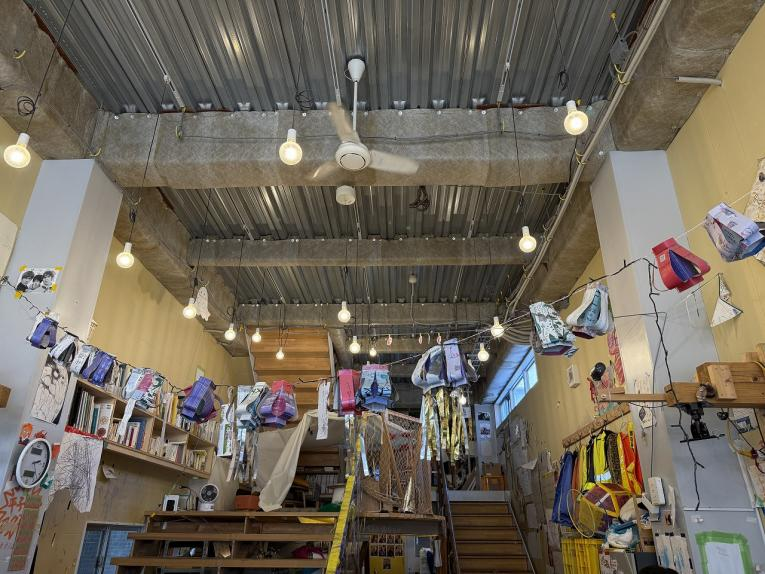
SOTOCHIKU materials are used in spatial projects, and when the proceeds are converted into cash for materials, 60% of the amount is donated to one of three wonderful NPOs. Those who donate materials will receive a donation certificate from the NPO, and a system is in place to allow them to claim a donation deduction when filing their tax returns. Last June, we visited each of the NPOs and introduced them one by one in the SOTOCHIKU newsletter.
This time, we’re featuring Creative Support Let’s, a certified NPO located in the central urban area of Hamamatsu City, Shizuoka Prefecture. “Takeshi Cultural Center Renjakucho” has a cultural center and disability welfare service facility on the first and second floors, and on the third floor there is a shared house and guesthouse that can be used by people with and without disabilities, primarily those with severe intellectual disabilities. In addition, “Chimata Community Center” is a privately run community center that can be used and used by anyone, with or without disabilities. It simply provides a place where you can be yourself. Furthermore, a large new base is scheduled to open in 2028.
Let’s introduces itself on their website as follows:
…
I don’t care about what society considers “normal.”
Takeshi, a severely intellectually disabled man, sticks to being “just the way he is.”
It was through meeting him that the certified NPO Creative Support Let’s was born.
We are an art-focused non-profit organization aiming to create a society where people can live together, overcoming all differences, including disability, nationality, gender, and age.
Instead of unilaterally judging everyone’s inherent ability to express themselves as insignificant or useless, we want to fully affirm it as a unique form of expression. We call this “Below Expression, “
and we aim to create a space where people from diverse backgrounds can intersect, thereby fostering a new culture.
Let’s is a welfare facility that started with “Takeshi,” and it works to expand a network of people in the city who interact with people with disabilities on a one-on-one basis, rather than treating them as a normal group. It is an unprecedented and energetic activity, and the process of trial and error continues to this day.
When we were looking for an NPO to donate to when we started SOTOCHIKU’s activities, we were introduced to Let’s by Kanji Sekine of “Kobo-e” / “studio COOCA,” who has been working since the 1990s to bring art by people with intellectual disabilities to the world as sophisticated goods.
Sekine-san’s work is also wonderful, based on one-on-one interaction. Since the early days of Gridframe, we have provided support for exhibitions and helped create the space for her workshop. That experience has become one of the origins of our own work.
To create a society where “a person’s value is not measured by their productivity,” I believe it is necessary to expand situations in society where people can experience the richness of “open sets” (i.e., the interior that is open because it does not belong to any boundary (properties, meaning, efficiency)). However, to support this situation, “closed sets” (i.e., the exterior that is closed because it belongs to a boundary (properties, meaning, efficiency)) that bring material wealth must also be fulfilling in society.
The problem is that current society is only expanding the concept of “closed sets,” while confining our “open sets” to a narrow space. However, simply advocating for the expansion of “open sets” will only lead to isolation from society.
It’s important to never separate “closed sets” and “open sets,” but to connect them like a Möbius strip. Both Let’s and studio COOCA have beautifully connected the two in their own ways.
We have a dream of one day being able to help connect two things spatially.

In the next issue, we will continue to share information about SOTOCHIKU’s various activities.
<SOTOCHIKU Newsletter Archive>
Issues published more than a month ago can be viewed on the archive page.
https://sotochiku.com/category/tsu-shin-archive/
We would be delighted to receive your feedback and suggestions regarding the SOTOCHIKU newsletter.
Thank you very much.
If you wish to unsubscribe, please contact Tanaka via Facebook message or email at tanaka@gridframe.co.jp.
February 28, 2026 GRIDFRAME Minoru Tanaka



Comments are closed